



Personalised marketing: How to get it right – 3 examples
28 September 2021
Personalised marketing: How to get it right – 3 examples
Today’s consumers expect personalisation, and brands that use data-driven marketing campaigns to achieve this are seeing the results.
In fact, your customers don’t just expect personalisation – they appreciate it.
But adopting a more personalised approach isn’t just about giving consumers more of what they want; it’s also about responding to complex changes in their behaviour.
And that’s not all! It’s important to realise that personalisation has transformed marketing from the ground up, improving the customer experience and, in turn, making businesses more profitable. Yet many companies continue to struggle with its implementation.
That’s why we believe it’s time for us to support you. This article will serve as your guide, as we’ll be covering the following points:
What is personalised marketing?
Definition of personalised marketing
Personalised marketing is the practice of using data to deliver targeted brand messages to individual prospects.
This method differs from traditional marketing, which mainly involved casting a wide net to win a small number of customers. With billboards, telephone calls, direct mail and so on, traditional marketing prioritises the volume of messages rather than their relevance.
Today, analytics have become more sophisticated and the amount of data on individual prospects has increased. Marketers now capitalise on both of these factors to deliver the most relevant message to prospects at the right time.
4 benefits of personalised marketing
There are numerous benefits to personalised marketing, for both businesses and consumers. When strategies are successfully implemented, the following benefits come into play:
1. Improved customer experience
Customers are more willing to provide personal information to their favourite brands if they get something in return.
2. Increased revenue
Businesses can increase their return on investment by identifying customers’ individual needs.
With the right automation technology, marketing managers can identify the channel through which customers engage, and then automatically follow up across all channels as part of an omnichannel approach.
3. Increased brand loyalty
When consumers provide information and data, they expect to be treated as unique individuals with specific preferences.
Businesses that invest time and resources in implementing effective personalised marketing strategies will gain a competitive advantage in terms of brand loyalty and customer satisfaction.
4. Consistency across channels
Consumers interact with brands through multiple channels, including email, social media, mobile messaging, etc., sometimes all within a single day.
For this reason, it is more important than ever for brands to ensure consistency across the various channels.
How can this be achieved? Well, your website, your newsletter and your marketing strategies are all channels you can use to implement personalised marketing. Let’s explore three categories of personalised marketing together.
The three categories of personalised marketing
If you’re considering implementing a personalisation system within your marketing organisation or expanding your existing infrastructure, you need to be aware of your options.
Just as standard marketing does not adequately meet the needs of individual customers, a standard approach to personalisation is not optimal. Below, we outline three main approaches.
Recommendation engines
Content filtering
Content filtering systems compare items against users’ individual preferences. For example, such a system may ‘see’ that a user tends to buy trousers online rather than jackets; it will therefore recommend trousers rather than jackets.
Collaborative filtering
To address some of the limitations of content-based filtering, collaborative filtering uses both similarities between users and between items to provide recommendations.
This allows for serendipitous recommendations; in other words, collaborative filtering models can recommend an item to user A based on the interests of a similar user, B.
Hybrid systems
Hybrid recommendation systems combine two or more recommendation strategies in various ways to derive complementary benefits.
This filtering takes into account both the individual user’s relationship with items and the user’s relationship with other users.
Real-time personalisation
Real-time personalisation, as the name suggests, personalises the user experience in real time.
It draws on both real-time and historical data, such as:
- the time of day
- geographical location
- the type of device used
- purchase history
Now that we’ve had a look at the approaches you can take, let’s examine the difference between personalisation and hyper-personalisation.
What is the difference between personalisation and hyper-personalisation?
Personalisation uses basic data provided by the customer, such as username, gender or location, to tailor messages that speak directly to the user as an individual.
Hyper-personalisation goes much further and includes information relating to the user’s browsing behaviour, even offline, in order to meet their specific needs and desires and send them highly relevant messages or even arrange an appointment.
This practice can be applied to almost all digital marketing channels, such as text messages, apps, websites, etc. But we believe that email also plays a very important role.
You may now feel you’ve gained a broad overview of our topic, but we’d like to take you a step further. Let’s explore the key elements of personalised marketing.
The key elements of personalised marketing
When we think of a personalised marketing campaign, the word ‘creative’ doesn’t necessarily spring to mind. Yet the creative elements of personalised marketing are essential, as they have made it possible to create adverts that are both successful and memorable.
So, what elements can you use to boost your personalised marketing strategy?
To push the boundaries, here are a few suggestions:
- The customer’s name in the spotlight
- Location-based communications
- An original GIF
- Photos and customer testimonials
- Special offers or other gifts
- Personalised landing pages
- Product recommendations based on purchase history
The list of elements you’ll need is long. The best approach is to find the mix of these elements that best suits your brand.
So, get creative!
If you’re thinking of starting to implement more personalised marketing, we strongly suggest you link it to your customer journey.
How do you do that? Here’s how.
How can you use personalised marketing based on the customer journey?
There are several different approaches to mapping customer journeys. One of them is similar to prescriptive personalisation.
It involves marketers drawing on their knowledge of the customer and their behaviour to group customer behaviours into different segments and create generalised models of the customer journey.
For example, a scenario might classify people who have clicked on products without buying them as ‘explorers’ who need more information about a product or set of products before committing to a purchase.
This scenario could send these customers an email providing them with further information.
Another benefit of optimising the customer journey is that it takes into account a broader range of interactions between customers and brands than recommendation engines do.
The ability to focus on the long term enables brands to make progress towards strategic objectives such as increasing customer lifetime value and loyalty by aligning their approach with each customer’s journey over time.
We know! Examples make things clearer.
3 examples of personalised marketing to inspire you
Today, the typical consumer expects personalisation to be present in all your brand’s marketing campaigns. Here are a few examples of personalised campaigns that can lead to great success.
1. Targeted emails
Marketers use personalisation to give their email campaigns a boost. Thanks to personalisation, they can create and send tailored emails to a specific group with particular needs
What sort of emails can you send?
- Send birthday emails
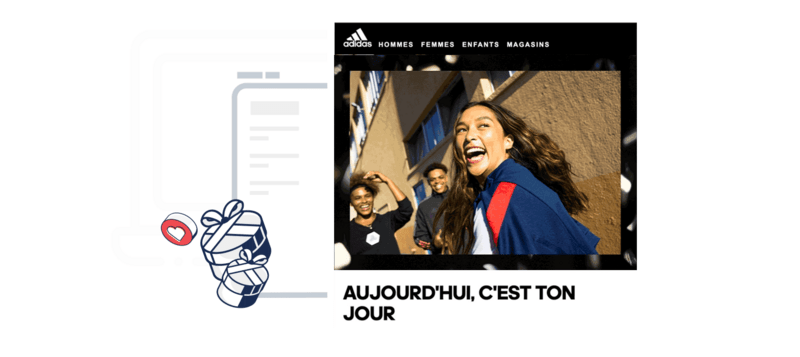
This birthday email is an excellent example of how Adidas uses something as simple as a date to deliver an exceptional experience. Adidas uses an animated GIF and offers a special deal redeemable online or in a local shop via a barcode.
- Send emails to wish customers a happy birthday
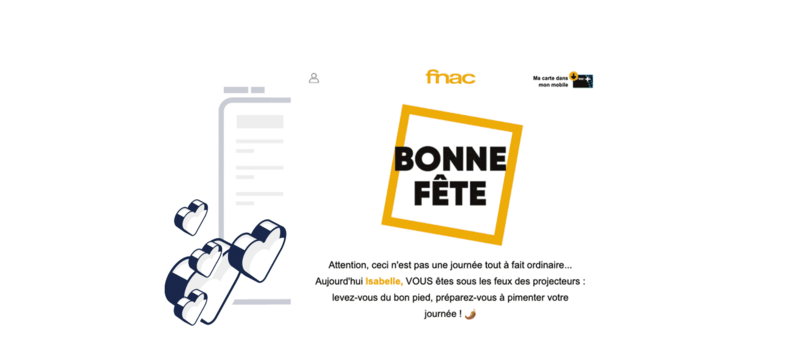
As with the birthday email, you can also use the ‘first name’ data to send your customer a birthday greeting. Here’s a very good example from Fnac, which takes the opportunity to promote different product categories.
- Suggest products to your customers
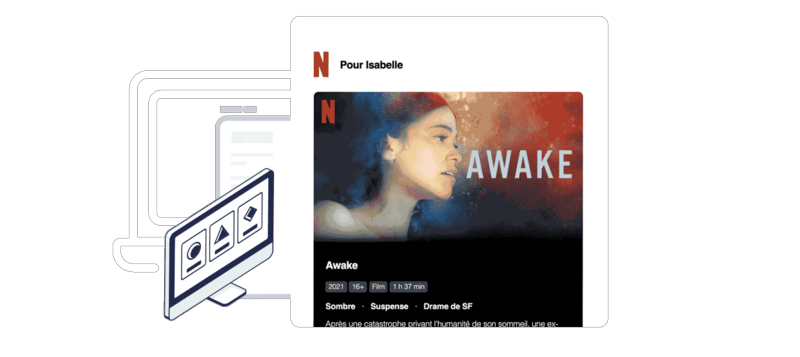
Aware that its content library can be overwhelming, Netflix regularly sends personalised emails suggesting films or series to its users, based on what they’ve watched, their saved preferences or new releases on the platform.
- Send follow-up emails
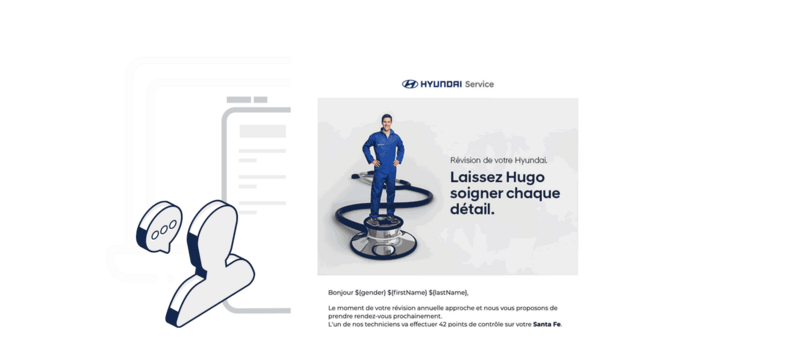
Isn’t it great when you’re reminded that your car’s service is coming up? Here’s an example from our client Hyundai, which sends a reminder to its customers based on the date of their last service and offers a special deal. If you can also personalise the email with a photo of one of your staff members who’ll be servicing the vehicle, you’ve got it made!
- Make the most of seasonal trends
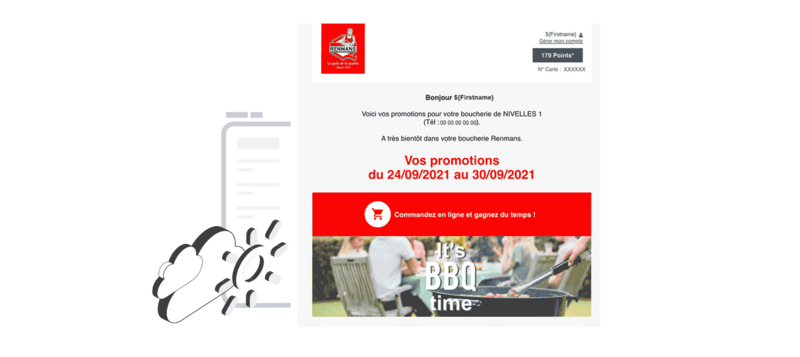
Do you sell seasonal products? Why not personalise your email with weather data, for example? That’s exactly what our client Renmans did: to promote the barbecue season – and therefore their wire mesh products – they included the weather forecast for the coming days. Clever, isn’t it?
2. Personalised video messages
Today’s customers are captivated by visuals; it’s the content that grabs their attention the most. Neglecting to include engaging videos and photos can therefore reduce your customers’ interest in your brand.
Personalised videos can be the best way to ensure you capture your customers’ attention and interest.
Although this type of personalisation is memorable for your audience, it can be time-consuming and costly.
So make sure you have the necessary tools and resources to make this approach as scalable and effective as possible.
3. Social media marketing
Engaging with consumers and potential customers on social media can help increase your visibility and customer loyalty.
Social media has taken centre stage in multi-channel initiatives and has helped to foster online conversations, enabling brands to remain top of mind with potential customers.
By sending personalised and relevant messages on social media through automation, marketers are able to collect data via these channels, which helps to improve communication and drive conversions. The relationship remains authentic and ongoing.
Now that you know more about personalisation and understand the difference between it and hyper-personalisation, let’s look at why now is the right time to move from personalisation to hyper-personalisation.
Moving from personalisation to hyper-personalisation
Hyper-personalisation is an extension of personalisation.
Whilst personalisation involves a thorough understanding and use of buyer personas, data and analytics, hyper-personalisation utilises real-time data and artificial intelligence to create even more personalised journeys for customers.
These personalised experiences can be used to deliver relevant content, products or services based on the buyer’s behaviour at that precise moment.
Hyper-personalisation is the next step in the evolution of the customer experience for your business.
Today, you don’t need sophisticated tools or a huge team to make the right recommendation for a product, service or piece of content.
However, for brands to derive maximum value from hyper-personalisation, they will need to utilise hyper-personalisation tools such as Actito.
Whereas many tools struggle to simplify complex data infrastructures, Actito prides itself on making all types of data accessible to marketers, whilst also ensuring data models remain flexible enough to adapt as new customer data emerges.
Actito offers you an analysis of your prospects. The solution also provides clearer insights that drive smarter, more effective and more efficient customer engagement, which helps to shorten the sales cycle whilst remaining true to the ultimate goal of delivering more enjoyable customer experiences.
Final thoughts
More than ever, consumers are demanding greater personalisation throughout the customer journey.
If your personalised marketing strategy isn’t properly tailored to each individual, they won’t feel engaged and will therefore be less inclined to buy from you.
Implementing an effective personalised marketing strategy can be your business’s greatest asset, and all you need to succeed is to try Actito now.