



What is marketing automation and how does it work in 7 examples?
20 October 2021
What is marketing automation and how does it work in 7 examples?
In an era where customer experience is more than ever a key differentiating factor, companies must redouble their efforts to offer personalized and engaging journeys.This is precisely what marketing automation promises, which simply consists of automating and optimizing interactions with prospects and customers based on their behaviors and preferences.
But specifically, what is marketing automation today? How has it evolved in recent years and how does it differ from good old email marketing?
What are its main benefits for businesses and how can you implement an effective automation strategy?
That's what we'll explore in this article, through 7 concrete examples of application.
Whether you're already familiar with the subject or just discovering the potential of marketing automation, you'll find food for thought and inspiration here.
What is marketing automation today?
Marketing automation isn't new.
Emerging in the 1990s with the rise of the web and email, it was first used to automate the sending of newsletters and promotional campaigns.
But in the last 20 years, with the multiplication of digital touchpoints and the explosion of customer data, marketing automation has evolved considerably.
An updated definition of marketing automation
Today, marketing automation refers to all tools and techniques that allow marketing processes to be automated, from lead generation to customer loyalty, including qualification, lead nurturing, and conversion.
In practice, this involves:
- Collecting and analyzing customer data (behaviors, interests, preferred channels...).
- Creating segments and profiles to adapt messages and content.
- Defining automated action scenarios, triggered according to behavior-based rules.
- Delivering the right message to the right person at the right time on the right channel.
- Analyzing performance to continuously optimize campaigns.
The evolution of marketing automation
While the basic principles haven't fundamentally changed, marketing automation has gained power and precision thanks to technological advances.
The rise of big data and machine learning in particular allows for collecting much more customer data and analyzing it more finely. Algorithms can identify weak signals, predict behaviors, and optimize journeys in real-time.
In parallel, marketing automation platforms have been enriched with numerous features: multichannel, lead scoring, A/B testing, advanced analytics, AI...
They also integrate much more easily with other tools in the marketing stack (CRM, CMS, ad servers...).
Marketing automation vs Email marketing
Despite these developments, marketing automation is still often confused with email marketing.
However, the differences are notable:
- Email marketing involves sending email campaigns to contact lists. Marketing automation orchestrates multichannel marketing scenarios (email, SMS, push notifications, web...) based on each customer's profile and actions.
- Email marketing relies mainly on demographic and declarative data. Marketing automation uses all behavioral data (purchase history, web browsing, customer service interactions...).
- Email marketing aims to push mass communications. Marketing automation seeks to enter into conversation with each individual in a personalized way.
- Email marketing measures campaign success by email performance (open rates, clicks...). Marketing automation evaluates impact across the entire customer lifecycle (conversion rates by segment, customer lifetime value, retention rates...).
Of course, email remains the preferred channel for marketing automation, particularly for its ability to deliver rich and targeted messages.
But in marketing automation, email is integrated into broader cross-channel journey logics, in line with new consumer habits.
The key advantages of marketing automation
If more and more companies are making marketing automation a priority, it's because it offers numerous tangible benefits.
Here's an overview of the main advantages to expect.
Large-scale personalization
With the omnipresence of digital, consumers are more demanding than ever in terms of relevance and personalization: they expect brands to speak to them uniquely, based on their interests, preferences, and interaction history.
Marketing automation perfectly meets this expectation by enabling the creation of tailored and engaging experiences at scale.
Marketing automation aims to deliver the right content to each individual, at the right time and on the right channel. And this in an automated way, without systematic human intervention. That's the promise.
How does it achieve this? By making the best use of available customer data.
For example, by identifying product pages viewed by a visitor, we can automatically send them an email with a selection of complementary articles or offer them a promo code for their next purchase.
Data (and especially its proper use) makes ultra-targeted and automated personalization possible.
Customer journey optimization
Beyond message relevance, marketing automation allows optimization of the entire customer journey, from brand discovery to purchase and after-sales.
The sequence of actions that makes up the scenario program can be continuously adjusted based on the analysis of customer behaviors at each stage of the lifecycle. The goal? Maximize conversions and customer loyalty.
For example, it's possible to:
- Accelerate the registration process with pre-filled forms.
- Retarget a prospect who visited a page without converting.
- Re-engage a customer who hasn't returned in X days.
- Propose an upgrade to a customer following their last purchase.
Because it helps streamline and contextualize the customer journey, marketing automation is a powerful tool for improving overall experience and customer satisfaction.
This naturally translates into business performance: increased conversion rates, average basket size, purchase recurrence, and ultimately revenue.
Improved operational efficiency
Beyond experiential and business benefits, marketing automation also improves marketing team efficiency.
Why? Because it allows automation of repetitive and time-consuming tasks, whether it's segment creation, campaign sending, lead scoring, marketing follow-ups...
Result: marketers can focus on higher value-added activities, such as data analysis, A/B testing, sales collaboration, monitoring.
It's therefore an interesting lever to promote marketing team skill development and evolve their missions towards more strategic management.
Real-time performance measurement and analysis
Finally, one of the great advantages of marketing automation is being able to track campaign performance in real-time.
Marketing automation platforms provide access to key KPIs in just a few clicks, whether it's the number of leads generated, open and click rates, conversion rates by channel and segment, ROI...
And thanks to advanced reporting and machine learning, it becomes even easier to analyze results finely and detect optimization levers.
For example, you can identify the most effective messages and visuals, spot abandonments in a purchase funnel, compare behaviors by segment. And of course, adjust your strategy accordingly: that's the purpose of dashboards.
Time savings and focus on strategic tasks
By delegating repetitive and time-consuming tasks to machines, marketing automation allows teams to focus on real strategic issues:
- Understanding customers.
- Designing the best experiences.
- Innovating.
- Collaborating with other departments.
All higher value-added activities that elevate the marketing function.
How to implement an effective marketing automation strategy?
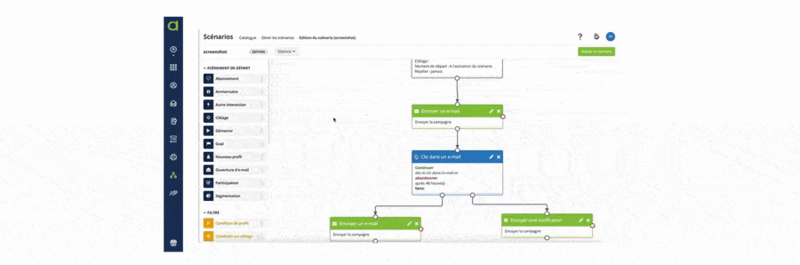
Now that the advantages of marketing automation are clear, the question remains how to concretely approach implementing it in your company.
Here are the main steps to follow to implement an effective marketing automation strategy.
Defining objectives and KPIs
As with any major project, the first step is to set a course, meaning clear and measurable objectives. Having precise indicators then allows tracking the performance of implemented actions.
What are your objectives:
- Generate more qualified leads?
- Accelerate sales?
- Boost retention and loyalty?
- Reduce customer acquisition costs?
Based on these business objectives, specific marketing KPIs can be defined: number of MQLs, conversion rate by funnel stage, revenue generated by campaigns, customer lifetime value...
Audience analysis and customer journey mapping
The next step will consist of deepening customer knowledge by finely analyzing available data:
- Who are my target buyers and prospects?
- What are their pain points, expectations, and motivations?
- What are the key touchpoints with my brand?
- What are the typical purchase journeys by segment?
This involves mapping the different stages of the customer lifecycle and identifying the most conducive interactions for triggering actions.
This will then allow defining the most relevant automation scenarios by segment and stage.
To enrich this knowledge, you can also conduct customer surveys and interviews, do user testing, or exploit support and sales feedback. The idea, as you'll understand, is to have the most complete vision possible of customer experience and needs.
Choosing the right platform
Once the strategy and journeys are defined, you need to choose the marketing automation platform best suited to your needs.
Many criteria come into play. Here are the main ones:
- Ergonomics and ease of use for teams.
- Features offered (predictive scoring, nurturing, A/B testing...).
- Level of integration with other tools (CRM, CMS, ad servers...).
- Quality and level of customer support.
- Platform scalability.
- And of course cost, with different pricing models possible.
To delve deeper into this key topic, we invite you to discover our 5 tips for choosing your marketing automation solution.
Designing workflows and scenarios
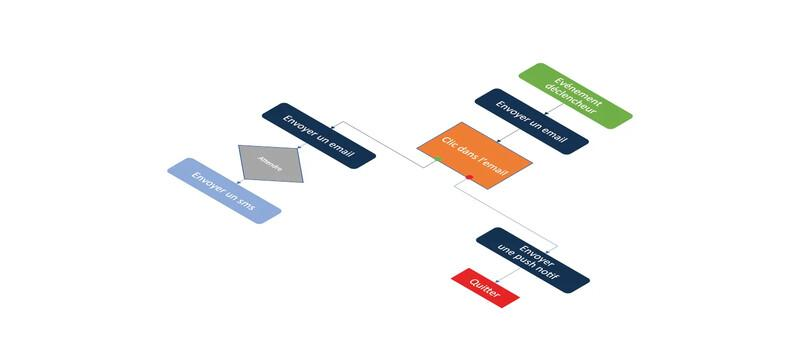
The heart of marketing automation strategy lies in designing workflows and scenarios, meaning sequences of automated actions to implement.
A workflow generally consists of:
- A trigger event: form filling, page visit, purchase... Known as a "trigger" in English.
- Conditions and filters: demographic criteria, lead score, product category...
- One or more actions: sending an email, creating a task for a salesperson, assigning a discount...
- Delays: time between actions.
A simple workflow example to demystify this unnecessarily obscure term: when a customer subscribes to the store's newsletter (event), if they made a purchase in the last 30 days (condition), then send them a welcome promo code email (action 1) and automatically add a virtual loyalty card to their customer account (action 2) valid for 7 days (delay).
Let's say it straight away, workflow design requires rigor and creativity to imagine the best possible combinations of actions and messages, based on objectives and customer insights.
Integration with other martech tools
To give marketing automation its full power, it's essential to properly integrate your marketing automation software with other tools in the marketing stack.
The main integrations to plan for are:
- CRM, to synchronize customer/prospect data between both platforms and trigger marketing actions based on CRM status (new customer, high-potential customer, churn risk...).
- Analytics tools, to enrich behavioral data and measure action performance.
- Content management platforms (DAM), to centralize and organize all marketing assets used in automated campaigns.
- Website CMS, to personalize content and messages based on user profile.
- Customer service management platform, to have a 360° view of the customer and connect their marketing and support interactions.
The more synchronized and centralized the data, the finer and more effective targeting and personalization will be. So it's a key element to consider in your marketing automation project.
Testing and continuous optimization
Once workflows are operational, the challenge will be to continuously monitor their performance to optimize them.
It's a permanent improvement process, based on results analysis and testing.
The trifecta to keep in mind is: measure, test, adjust.
In this perspective, A/B Testing is the marketer's essential tool for optimizing automation campaigns. This method consists of testing different versions of the same element (subject, content, visual, journey...) with two similar samples to identify the most effective version.
Optimization is an endless work that requires perseverance and agility. But this is the price at which marketing automation delivers its full potential and produces tangible results over time.
7 examples of marketing automation workflows
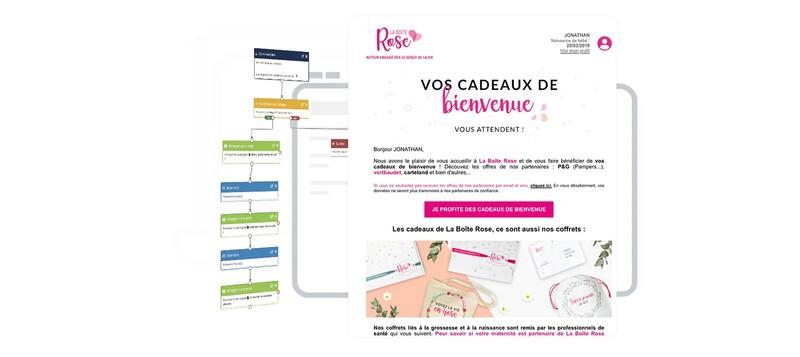
To inspire you in designing your own scenarios, here are 7 examples of marketing automation workflows that have proven their worth.
Onboarding
Onboarding, very close to the welcome scenario, falls within the first phases of the relationship and aims to boost engagement of new customers or subscribers.
The onboarding scenario is a sequence of messages and/or actions aimed at engaging conversation with a new prospect who has just signed up or created their account.
The challenge is to confirm their interest then gently "onboard" them by accompanying them in their first steps.
An effective onboarding workflow generally mixes welcome emails, product/service information, help content (guides, FAQs, demos...) and calls to action (free trial, promo code...).
Lead nurturing
Lead nurturing workflows, mostly used in B2B marketing, address prospects who have already shown interest (newsletter subscription, demo request...) but aren't yet ready to buy.
The goal? Maintain the relationship to gradually bring them to maturity.
A nurturing journey generally offers a mix of informative, educational, and promotional content sent at regular intervals. It adapts based on prospect interactions (if they opened an email, visited a page...) to personalize messages and tempo.
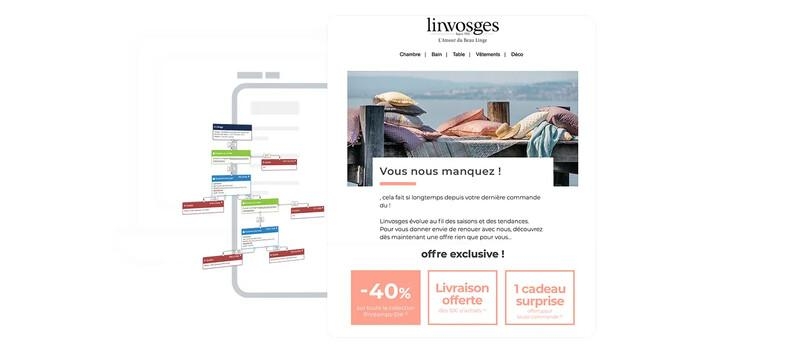
Reactivating inactive customers
Inactive customers are often neglected by companies, wrongly. It's always easier and less costly to reactivate an inactive customer than acquire a new one. Hence the interest in reactivation scenarios.
Some ideas for your reactivation workflow:
- Request customer feedback (what did you think of your last order?).
- Play the FOMO card (we miss you, come back soon!).
- Offer a special re-engagement offer (30% off your next purchase).
- Remind them of loyalty program benefits.
The important thing is not to rush the customer but rather gently make them want to return.
More details in our guide "How to reactivate inactive customers".
Upsell and cross-sell
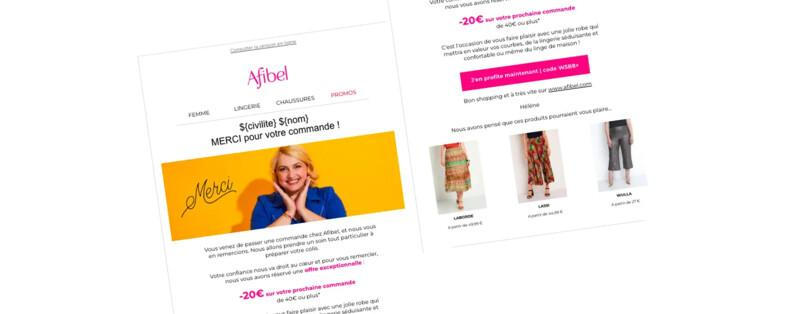
Upsell and cross-sell scenarios target your buyers and aim to generate additional revenue from them.
Two techniques are possible:
- Upsell, which consists of offering a higher-range product or complementary options.
- Cross-sell, which consists of recommending related products often bought together.
For example, for a hotel, you could suggest to a customer who booked a standard room to upgrade to a suite (upsell) or add breakfast and parking (cross-sell).
Right timing and tone are essential to not appear too intrusive. The idea is to bring additional service in a relevant way.
For more detail, read our article dedicated to upselling and cross-selling.
Cart abandonment recovery
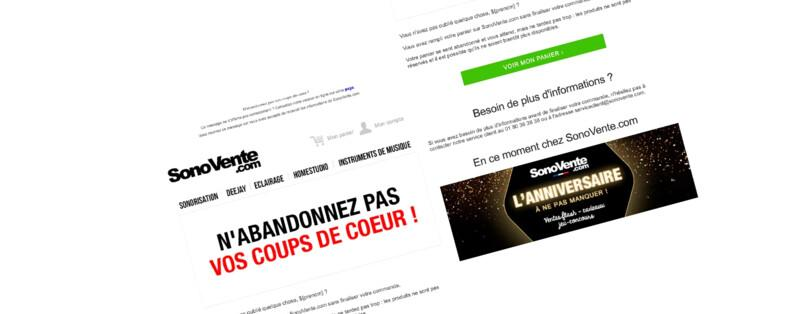
Let's come to the famous cart abandonment recovery workflow...
The principle is simple: encourage the user to complete an order they left pending.
An effective workflow generally offers a series of 2 or 3 emails sent in the hours and days following abandonment:
- A first reminder email sent within the hour.
- A second more incentivizing email 24h after (with addition of a discount code for example).
- A final follow-up email after 3 days.
It's estimated that a well-designed cart abandonment email can help recover up to 20% of lost sales. A non-negligible lever therefore!
Behavior-based campaigns
Workflows directly triggered by user actions on the website or mobile app, that's the holy grail of automation!
For example:
- Send a discount to a customer who views a product several times without adding it to cart.
- Offer a demo to a lead who visited 3 pages of the site in the same session.
- Invite to participate in a satisfaction survey after contact with customer support.
Exploitation of behavioral data is the sign of mature marketing automation practice and the approach that generally generates the best results.
Loyalty and retention programs
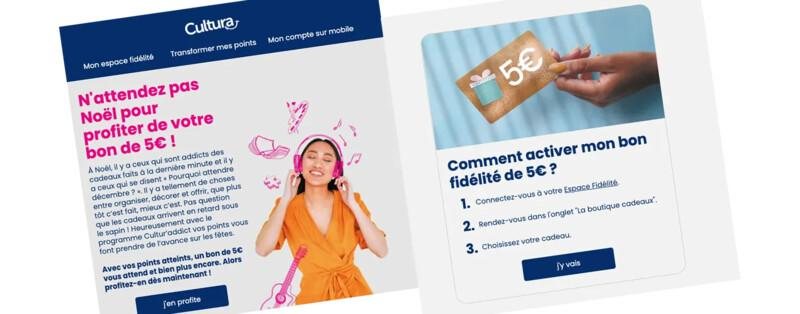
Finally, a last key use of marketing automation concerns relationship programs aimed at maintaining customer relationships over time.
Here we find the venerable regular newsletters, but also all scenarios related to loyalty programs: point attribution, status changes, privilege offers, event invitations...
The challenge is to continue animating the relationship by giving the customer good reasons to stay. Automation allows creating regular and personalized communications without too much increasing team workload.
Marketing automation trends to watch
Marketing automation hasn't finished evolving, driven by new technologies and new uses. Here are some major trends that will shape its future.
Artificial intelligence and machine learning
This is probably THE big revolution to come. By applying machine learning to customer data, it becomes possible to create ultra-targeted and predictive experiences, adapted in real-time to each individual's context and reactions.
Concretely, this allows for example:
- Automatically adjusting frequency and content of messages based on recipient preferences and engagement.
- Triggering actions on weak signals or micro-behaviors detected by algorithms.
- Anticipating customer needs and intentions before they even express them.
Hyperpersonalization
In the same spirit, the trend is clearly towards ever more personalization to recreate human connection at scale. Thanks to data crossing, targeting can be refined down to the individual level and create tailor-made content.
Rather than relying on personas or segments, we rely on each customer's unique and complete profile, with their demographic, behavioral, transactional data, but also declared or inferred preferences.
This is "one-to-one" personalization moving from dream to reality.
Conversational automation
Another strong trend is the development of conversational agents (chatbots, voicebots...) capable of dialoguing with customers in natural language. These virtual assistants are increasingly integrated into marketing automation platforms to automate interactions.
They allow instantly answering customer questions, guiding them in their purchase journey, or personalizing recommendations. All this 24/7, with great fluidity.
With AI progress, these conversational devices are becoming increasingly autonomous and proactive to handle complex requests.
Advanced integration with CRM and sales tools
Marketing automation is only effective if it's connected with other customer relationship building blocks. That's why we're seeing increasingly strong convergence between marketing automation software and CRM tools.
The goal is to enable alignment and real-time customer data sharing between marketing, sales, and support teams to orchestrate fluid and coherent journeys from end to end.
Concretely, the marketer can rely on CRM customer knowledge to refine targeting and personalize campaigns. On their side, the salesperson can use engagement data collected by marketing automation to adapt their sales pitch.
Key learnings
Marketing automation is now establishing itself as an essential lever for customer relationships.
Its benefits are multiple:
- Better customer knowledge and segmentation, thanks to data exploitation.
- Increased message personalization and relevance, adapted to each profile and journey.
- The ability to personalize messages in an advanced way, without manual intervention.
- An increase in marketing and commercial performance: conversion, loyalty, ROI.
- Time freed up for marketing teams who can thus focus on more strategic activities.
To reap all its fruits, implementing marketing automation should be considered as a true company project, mobilizing multiple stakeholders around customer knowledge.
There's a whole work to be done upstream to lay the foundations of an effective marketing automation system: journey analysis, scenario definition, tool selection, KPI definition, permanent testing...